Apartment SEO: the checklist for property websites, Google Maps and AI answers
Apartment SEO is not one website. It is three places a renter finds you: your property website, your Google Maps listing, and the answer an AI assistant gives. Here is the checklist we work through for each community, in the order that pays off fastest.
Apartment SEO is the work that brings renters to a community without paying for the click. For a single property it comes down to three surfaces: the property website ranking for the searches renters actually type, the Google Business Profile showing in Google Maps, and AI assistants like ChatGPT, Gemini and Google AI Overviews giving the right name, prices and specials when asked. This checklist covers all three, in the order we fix them, followed by the weekly and monthly checks that keep a community from slipping back.
Which searches an apartment website can actually win
Start by being honest about the map. On a search like “apartments in [city],” listing sites cover every community in the market and usually own the top of the page. Chasing that term with a single property website is slow and rarely worth it. The searches a property website can win are narrower and closer to a tour:
- Your community’s name. You should be first, with your own site, your Business Profile on the right and no wrong phone number anywhere on the page.
- Neighborhood and submarket searches. “Apartments in [neighborhood],” “apartments near [employer, hospital or campus].”
- Floor plan and amenity searches. “2 bedroom apartments [city],” “apartments with a garage [suburb].”
- “Near me” searches in Google Maps. These are ranked on the Business Profile, not the website, which levels the field against much larger sites.
Write that list down for each community before touching the site. It decides which pages exist, what each one is titled and where the internal links point.
The apartment SEO checklist for the property website
Most property websites run on a template from the website vendor, so the fixes below are written as a punch list the vendor can ship. None of them needs a redesign.
1. Every important page can be found and indexed
Check Google Search Console for pages excluded from the index, especially floor plans, amenities, the neighborhood page and anything with the word “specials” in it. Templates sometimes block whole sections, or load floor plans inside a widget Google cannot read. Prices and availability that only appear inside a script are invisible to search engines and to AI assistants alike.
2. One page per search you want to win
A floor plans page that lists every unit type is fine for browsing, but a renter searching “2 bedroom apartments [city]” should land on a page about two-bedroom homes. Same for neighborhoods: one page that describes the area, the commute, nearby employers and what is walkable, written from the community’s point of view, not copied from a city guide.
3. Titles and headings that say where and what
Each page title should name the community, the city or neighborhood, and what the page is about. “Floor Plans” alone tells Google nothing. “1, 2 and 3 Bedroom Apartments in [Neighborhood], [City] | [Community]” does. The main heading on the page should match the same idea in plain words.
4. Name, address and phone that match everywhere
The community’s name, address and leasing phone number should be identical on the website, the Business Profile and the major listing sites. Mismatches, like an old tracking number on one page or a suite number on another, are one of the most common reasons a community shows the wrong details in Maps or in an AI answer.
5. Structured data for the community
Google’s guidance for local business structured data asks for the name and address at minimum, recommends phone, hours, location coordinates and the specific page URL, and says to use the most specific business type available. For apartments, schema.org has a type for exactly this: ApartmentComplex. One caution from the same page: review star markup is meant for sites that review other businesses, so marking up your own testimonials as star ratings is not the shortcut it looks like.
6. Speed and phone layout
Most renters look at apartments on a phone. Large photo galleries, virtual tour embeds and chat widgets are the usual reasons a property site is slow. Compress images, load tours on tap instead of on page load, and check that the “schedule a tour” button is visible without scrolling on a phone.
7. Prices and specials that are current, in plain text
Starting prices by bedroom and the current special, written as text on the page, with the date they changed. This matters for SEO, but it matters more for AI answers, because assistants quote whatever they last read. We wrote up why communities show the wrong rent in ChatGPT and what replaces it.
Google Maps: the Business Profile checklist
For “apartments near me” searches, the Google Business Profile is the page that ranks. Google says local results are based on three things: relevance, distance and prominence, and that there is no way to pay for a better local ranking. Distance you cannot change. The other two you can:
- Primary category set to apartment complex, with the website link pointing to the community’s own site, not a corporate page or a listing.
- Every field filled in: hours, leasing phone, amenities, accessibility details, pet policy and a description written for renters.
- Current photos of the homes, the amenities and the leasing office entrance, added regularly.
- Posts with the current special and starting prices, updated when they change.
- Reviews, asked for honestly and answered. Google notes that more reviews and positive ratings can help local ranking. Its review policy also prohibits offering incentives for reviews and asking only happy residents. Ask everyone, at move-in and when a maintenance request closes, and reply to every review, good or bad.
We cover the full routine on our Google Business Profile management page.
AI answers: the newest part of apartment SEO
Renters now ask ChatGPT, Gemini, Google AI Overviews, Google AI Mode and Bing Copilot which communities to look at, and what they cost. The good news is that this does not need a separate playbook. Google states that there are no additional requirements or special optimizations to appear in AI Overviews or AI Mode: the page has to be indexed and eligible to show in Search, and the usual fundamentals apply, such as crawlable pages, internal links and important content in text.
In practice, an assistant’s answer about your community is assembled from your website, your Business Profile, your reviews and the listing sites. So the AI checklist is mostly the two lists above, plus three habits:
- Ask the assistants yourself. Try the questions a renter would ask: “best apartments in [neighborhood],” “how much is a 2 bedroom at [community].” Note whether you are named and whether the price is right.
- Note who is cited instead. If the answer names a nearby community or quotes a listing site, that page has a fact yours is missing.
- Answer the questions on your own pages. A short, factual FAQ on the floor plans and neighborhood pages (parking, pets, utilities, commute) gives assistants something accurate to quote.
We track this weekly for every community on our AI search visibility service: how often each assistant names the community, which sites it cites instead, and whether the price it quotes is right.
The apartment SEO cadence we run
A checklist done once decays. Website updates remove tags, specials change, new reviews come in, and a competitor adds the neighborhood page you skipped. This is the cadence we keep for each community:
| How often | What we check | What it catches |
|---|---|---|
| Every afternoon | Prices and specials on the live website | A special that changed and needs to reach ads, posts and the Business Profile |
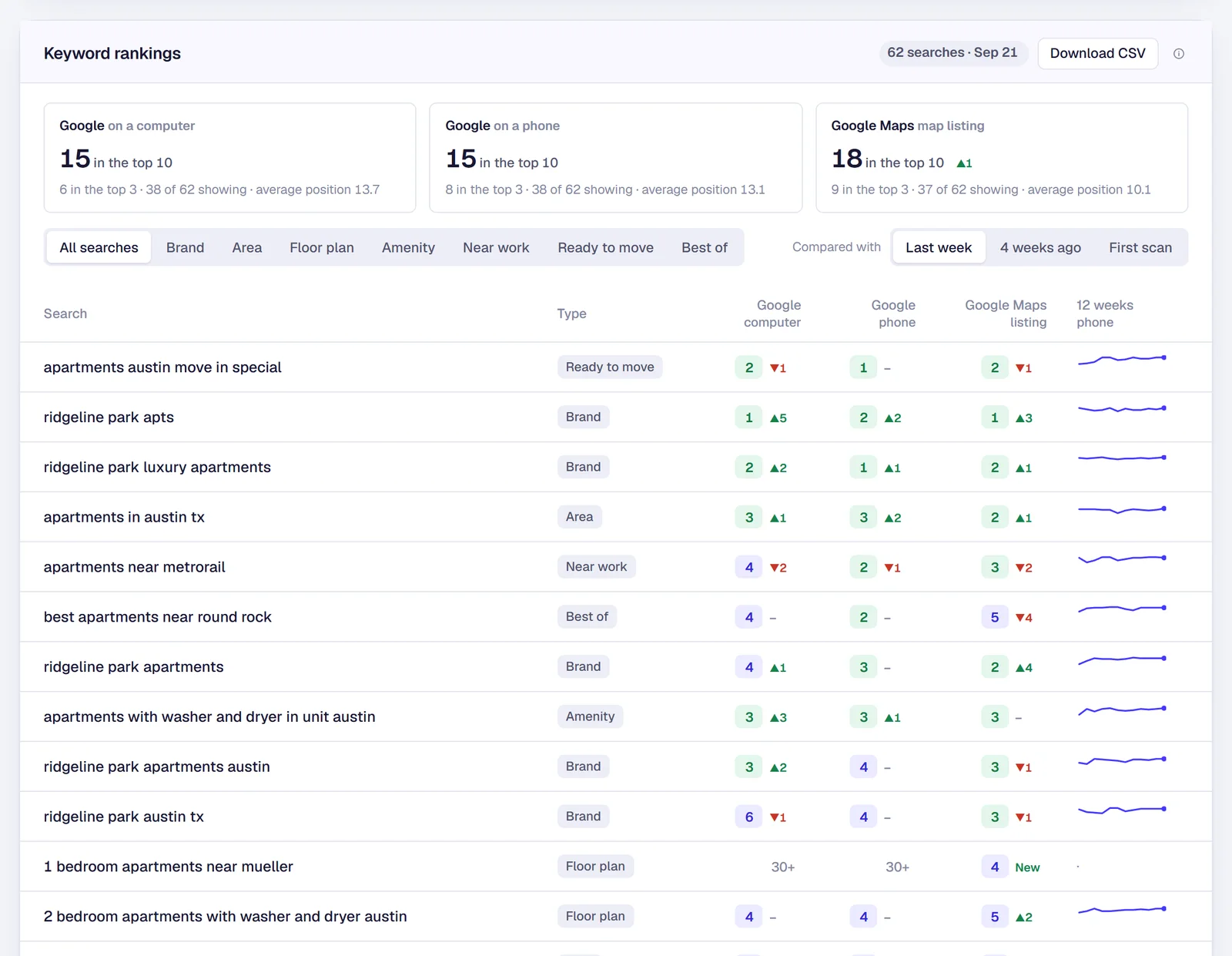
| Weekly | Rankings on a computer, a phone and Google Maps | A page or listing that slipped, before it shows up as fewer leads |
| Weekly | AI answers across five assistants | The community missing from answers, or a stale price being quoted |
| As they come in | New reviews, with a drafted reply | Unanswered reviews and recurring complaints worth fixing on site |
| Monthly | Site health: speed, broken links, phone layout, indexing | Template changes that quietly block pages or slow the site down |
| Monthly | Keyword gaps and the punch list for the web vendor | Searches with demand and no page to answer them |
Swipe sideways to see the full table →
All of it sits per community in Jamesday Marketing Pulse, next to paid ads and leads, so a regional manager can see whether a fix moved anything. The site checks and the punch list go to the property’s own web vendor, so nobody has to rebuild a website to get better rankings.
How to measure apartment SEO
Rankings are a leading signal, not the result. The result is renters who toured and leased. Track organic search and Google Maps the same way you track ads: calls that last a minute or more, tours booked and applications started, by source, joined to signed leases where the property management system allows it. Our cost per lease reporting does that join for every community, so SEO is graded on the same scale as paid search.
That scale is why SEO and Google Maps deserve the effort. Every lease that comes from a renter who found you on their own is a lease you did not pay a click or a listing fee for. On our case study portfolio, paid search runs at an estimated $188 per lease against a $588 industry average across all sources (REACH by RentCafe). Organic leases lower the blended number further.
The short version
Pick the searches a property website can win: name, neighborhood, floor plan and “near me.” Give each one a page with current facts in plain text. Make the name, address and phone match everywhere. Fill in the Business Profile, keep photos and posts current, and ask every resident for a review. Check what AI assistants say about you and fix the facts they get wrong. Then repeat the checks weekly and monthly. If you would rather have someone senior run that for you, that is our multifamily SEO and AI visibility service, with published pricing per property.
Questions about apartment SEO
What is apartment SEO?+
Apartment SEO is the work that gets a community found without paying for the click: its own website ranking for searches like “apartments in [neighborhood]” and “2 bedroom apartments [city],” its Google Business Profile showing in Google Maps, and AI assistants such as ChatGPT and Google AI Overviews naming it with the right prices. It is local SEO for one address, plus the facts renters ask about.
Can an apartment community outrank Apartments.com and Zillow?+
On broad city searches, usually not, and it is rarely worth trying. Listing sites cover every community in a market. Where a property website can win is the specific search: its own name, its neighborhood, a floor plan, a nearby employer or campus, and the Google Maps results for “apartments near me,” which are ranked on the Business Profile, not on domain size.
How long does SEO take for an apartment community?+
Business Profile fixes and correcting wrong facts on the website can show up within weeks, because Google and AI assistants re-read those often. New pages for neighborhoods and floor plans usually take a few months to settle into their positions. That is why we track rankings weekly: it shows which fixes are moving and which are not, long before a monthly report would.
Is SEO still worth it for apartments in 2026?+
Yes, and arguably more than before. Google says there are no special requirements to appear in AI Overviews or AI Mode beyond being indexed and eligible to show in Search. The same crawlable, accurate, well-linked property website that ranks in Google is what AI assistants read when a renter asks them about your community.
What is the most effective way to market apartments?+
For most stabilized communities, the combination that produces the cheapest leases is search: SEO and Google Maps for renters who find you on their own, Google Ads for the searches you cannot rank for yet, and listing sites where the market needs them. Grade each one on cost per signed lease, not on clicks.
Want this checklist run on one of your communities?
Send us one property. We will show you where it ranks on Google and Maps, what AI assistants say about it today, and the first fixes we would hand your web vendor.
The person on this call is the person in your ads account. Cameron Day, owner.