Facebook ads for apartments: what still works under Meta’s Housing ad rules
Facebook ads for apartments run under Meta’s Housing special ad category, which takes away most of the audience targeting people expect. What is left is still useful: a wide radius, your own website visitors, and an ad good enough to find the renter on its own.
Every Facebook and Instagram campaign that promotes an apartment community has to be declared as a Housing ad. That one setting decides who you can reach, and it is why advice written for restaurants and online stores goes wrong on apartments. This guide covers what the category removes, what still works, the three jobs we use Meta for, and how to tell whether it is paying for itself.
What the Housing special ad category removes
Meta publishes the rules in its developer documentation for special ad categories. For housing ads in the United States:
| Setting | Under the Housing category |
|---|---|
| Age | Fixed at 18 through 65+. You cannot narrow it. |
| Gender | All genders. You cannot choose one. |
| ZIP codes and neighborhoods | Not available as targeting. |
| Location radius | At least 15 miles around any city, address or pin you pick. |
| Location exclusions | Not available. |
| Lookalike audiences | Not available. |
| Behavior and demographic targeting | Not available. |
| Interests | Only from a list Meta has approved, and no interest exclusions. |
| Custom audiences (site visitors, lists) | Still available, with an eligibility check on customer lists. |
Swipe sideways to see the full table →
Source: Meta for Developers, Special Ad Categories, read November 2026. Meta updates these rules; check the page before you rebuild a campaign.
These rules exist because of fair housing law, and they apply to every advertiser. No agency has a workaround, and one that claims to is a risk to your account and your company. Google has its own version: see the targeting rules in our guide to Google Ads for apartments.
What still works in Facebook ads for apartments
A wide radius, written for the people already in it
Fifteen miles around a suburban community covers far more than its submarket. Rather than fight that, accept it. The ad has to make the location obvious in the first second: the neighborhood name, the street everyone knows, the drive to the job center or the trail. People outside the area who would never move there scroll past. People who would, stop.
Your own website visitors
Custom audiences built from your website are still allowed, and they are the most valuable audience you have on Meta. Someone who looked at your two bedroom floor plan last week and did not book a tour is one reminder away from a visit. This needs the Meta pixel on the community website, set up to pass page views and a lead or tour event. If it is missing, it is the first thing to fix.
Excluding current residents
A customer list of current residents, where Meta accepts it for housing campaigns, lets you exclude people who already live there from ads they do not need to see. It saves money on specials and stops an ad for a move-in deal from landing in front of a resident who is about to renew at the full rate.
Advantage+ audience
Meta’s automated audience works inside the Housing category. With the targeting levers gone, we let it find people and put the effort into the creative, which is the input that decides who it finds.
The three jobs we use Meta for
Meta is not where most renters go when they are ready to tour. That is search, on Google and Google Maps. Meta reaches people before they search and brings back people who already looked. We give it one of three jobs, never all of them in one campaign:
- Lease-up awareness. Before and during a lease-up, nobody knows the community’s name yet, so nobody searches for it. Meta builds that name in the area, grows an interest list, and feeds the brand searches that Google later captures.
- One slow floor plan. When a single unit type is sitting while the rest of the building leases, an ad for that floor plan, with its photos and price, sent to that floor plan’s page, moves it faster than a general community ad.
- A special. When the community runs a move-in special, a short campaign puts it in front of the area and in front of past visitors. We put the special in the headline, where people read it, and end the campaign on the day the special ends.
Remarketing to website visitors runs underneath all three, as its own ad set, all the time.
How to advertise an apartment on Facebook: the setup
- An ad account in the company’s name. Not the agency’s, not a leasing agent’s personal profile. If the agency leaves, the account, the pixel and the audiences stay with you.
- The Housing category on every campaign. Including remarketing and specials. It is set at the campaign level, so check it on every new campaign, not once per account.
- One location, 15 miles or wider, centered on the community’s address.
- A pixel event that means something. Count tour bookings and lead forms on your website, not page views or link clicks. Meta optimizes toward whatever you tell it to count.
- Tracked links. Every ad URL carries UTM tags with the community, the campaign and the ad, so your website analytics and your leasing system can tell Meta traffic apart from everything else.
- A landing page that matches the ad. A floor plan ad lands on that floor plan, with the price and a tour button. Not the home page.
Creative that books tours, and stays fair-housing safe
The rules on targeting have a partner rule on copy: describe the home, never the person who should live in it. In practice:
- Show the real place. Actual photos and short video of the units, the amenities and the view outperform stock images, and they set honest expectations for the tour.
- Lead with a fact. A price, a floor plan, a move-in date, a named location. “Two bedrooms from” with a number beats “luxury living” every time.
- Describe features, not residents. “Three bedrooms with a second living area” is safe. Wording about who the unit is perfect for, such as household type, age or life stage, is not. Read every headline and caption against fair housing, not just the ones that feel risky.
- Make specials plain. The offer, the floor plans it applies to and the date it ends, in words. No countdown pressure.
- Test one thing at a time. A new ad goes up against the current winner each week. The one bringing tours at the lowest cost keeps the budget.
How to judge Meta for apartments
Meta’s own reporting counts conversions generously, including people who saw an ad and later converted some other way. For a channel whose job is awareness and reminders, last-click reporting undersells it and Meta’s reporting oversells it. We judge it three ways:
- Tours and leads it sent directly, from the tracked links, in your website analytics and leasing system.
- What happened to the rest of your traffic. During a lease-up push, brand searches and direct visits should rise. If they do not, the ads are not building the name.
- Cost per signed lease, next to Google. Same denominator for every channel, from the leasing system. Our cost per lease calculator shows the arithmetic, and cost per lease reporting does it for every community, every month.
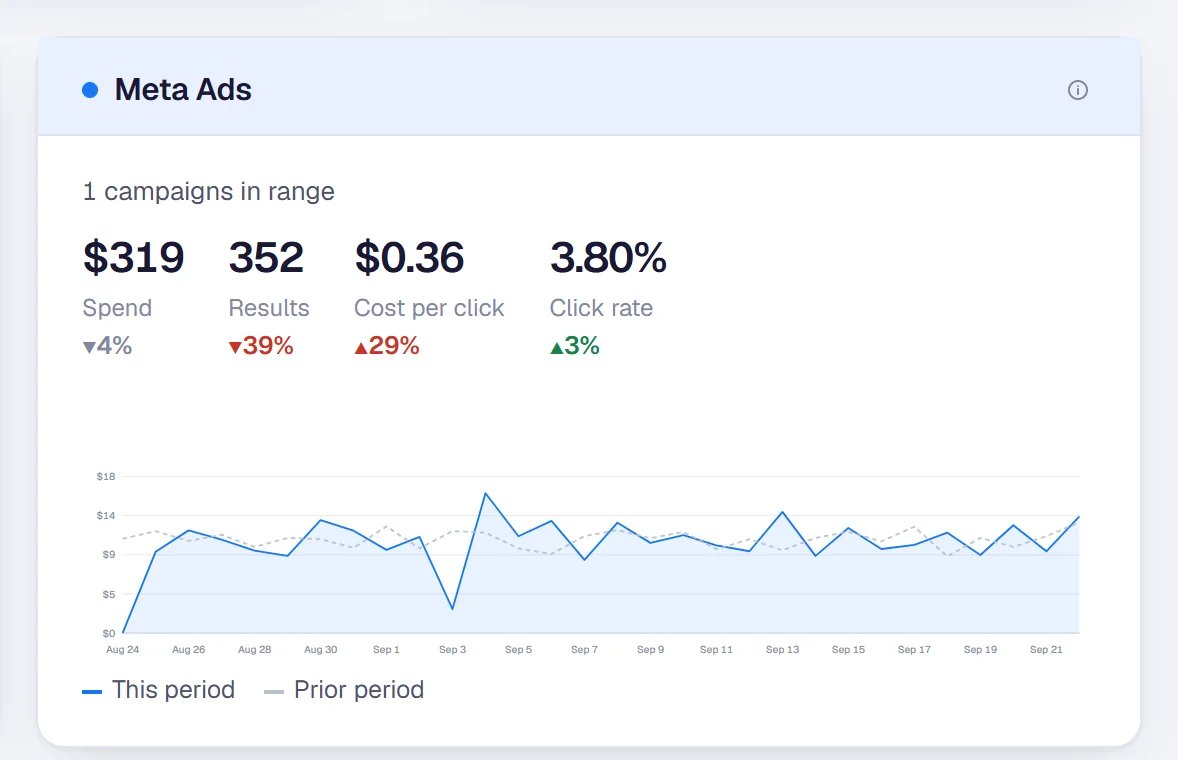
In Jamesday Marketing Pulse, every community’s Meta numbers sit next to its Google numbers and its website traffic by source, so a regional can see in one place whether Meta is doing its job.
Our weekly Meta checklist for each community
- Every active campaign is in the Housing category.
- The pixel fired tour and lead events this week, and the counts match the website.
- Every ad link carries UTM tags, and the landing page is live with the current price.
- Specials in ads match the specials on the website, and ended specials are off.
- A new ad is testing against the current winner.
- Frequency on remarketing is not climbing to the point where the same people see the same ad every day.
- Budget follows the job: more for a lease-up or a slow floor plan, less once it moves.
The short version
Facebook ads for apartments work when you stop trying to target people and start making ads that find them: a wide radius, real photos, a real price, a named place, and remarketing to everyone who already visited the site. Give Meta one job at a time, track it into tours and leases, and judge it next to Google rather than by its own count. If you want this run for you, see Meta ads for apartments within our paid advertising service and the published pricing.
Questions we hear about this
Do Facebook ads work for apartments?+
Yes, in a different role than Google. Meta rarely reaches someone ready to sign this week. It builds awareness before and during a lease-up, fills one slow floor plan, promotes a special, and brings back website visitors who did not book a tour. Judged on last click alone it looks weak, so judge it on tours and on what it does to the rest of your traffic.
How do I advertise a rental property on Facebook?+
For an apartment community, run paid ads from a Meta ad account in the company’s name, declare the Housing special ad category on every campaign, target a 15 mile or larger radius around the community, and send people to a floor plan or tour page on your own website with a tracked tour or lead conversion. Free Marketplace listings are a separate, organic route and do not replace paid ads.
Can we target renters by age, income, ZIP code or interests?+
No for age, gender and ZIP code: Meta fixes housing ads to ages 18 through 65+ and all genders, and does not allow postal code targeting. Behavior and demographic targeting are not available, and interests are limited to a list Meta has approved. No agency can switch these rules off. The ad, the offer and the landing page do the targeting work instead.
How much do Facebook ads cost for apartments?+
Cost per thousand views moves with the market, the season and the creative, so a single number is not useful. Set the budget from the job: a lease-up awareness push, one slow floor plan, or remarketing to past visitors each need different amounts. Then judge it by cost per tour and cost per signed lease, not by cost per view or per click.
What happens if we do not pick the Housing category?+
Meta requires housing ads to run in the category, and an ad that should be in it and is not can be rejected in review. Worse, it removes the guardrails that keep the targeting fair-housing safe. Declare it on every campaign that promotes a community, including remarketing and specials.
30 minutes, your accounts, your properties.
Bring one community's ad account. We'll show you where spend is leaking and what we'd do in the first 30 days. You keep the findings either way.
The person on this call is the person in your ads account. Cameron Day, owner.